
VISIT MARIE ANTOINETTE'S PRISON IN PARIS
The Conciergerie in Paris is the ancient royal palace on the Île de la Cité that became the prison where Marie Antoinette was held during the French Revolution. Today it preserves medieval rooms and traces of one of the most dramatic periods in French history.
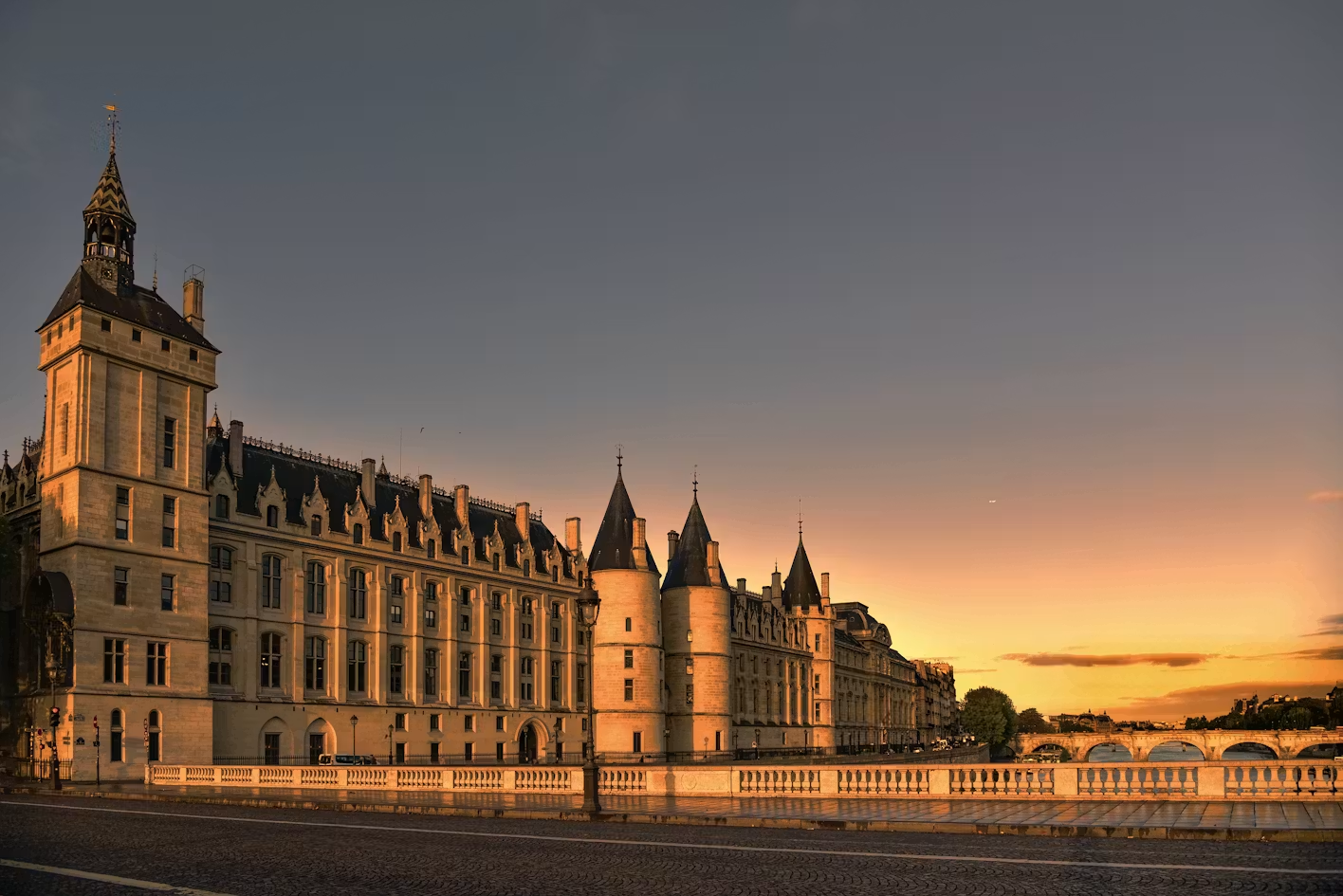
Visiting the Conciergerie today is not simply about stepping into a museum, but about facing an emotional and atmospheric impact that unsettles the visitor from the very first steps. Set in the heart of Paris, on the north bank of the Île de la Cité, the building presents itself from the outside as an austere, fairy-tale Gothic castle, its majestic towers reflected in the waters of the Seine. Once you pass through the entrance, the architecture stops being a mere backdrop and turns into a relentless time machine. The transition from the bright, lively exterior of modern Paris to the superb dimness of the Conciergerie happens in an instant. The air suddenly grows cooler, almost still, filled with the unmistakable smell of ancient stone, centuries-old damp and wrought iron that characterises places long isolated from the rest of the world. Visitors are welcomed by the magnificent breadth of the Salle des Gens d’Armes, an underground hall that stands out for its geometric perfection and vastness. Walking beneath the fourteenth-century Gothic vaults, supported by imposing pillars like trees of stone, creates a profound sense of vertigo. Light barely filters through the tall windows, creating striking chiaroscuro effects on the uneven floor. Here visitors grasp the great paradox of the Conciergerie: before becoming the antechamber of the guillotine, it was the seat of Capetian royal power, a palace of extraordinary luxury, where lavish banquets were held for thousands of courtiers. The contrast between medieval splendour and its tragic use during the French Revolution runs through the whole visit. As you continue along the route, the progressively shrinking space forces both body and mind into physical and mental contraction. From the wide communal halls you move into narrow corridors, where the ceilings drop and the stone walls seem to close in, almost suffocating. Here begins the full immersion into the details of the Reign of Terror. To help visitors interpret the now-bare, empty rooms, the visit is enhanced by the HistoPad, an augmented-reality tablet that acts as a window onto the past. Pointing the screen towards the corners of the prison, the stone walls come to life: straw beds, worn-down candles, clerks’ desks piled with paperwork, and the figures of the prisoners who once filled these spaces all appear.
The technology doesn’t distract but amplifies sensory perception, letting visitors picture the inhumane overcrowding, the smoke of pipes, the clatter of crockery and the desperate whispers that once filled the air. The route is designed as a dramatic crescendo. It is not a simple, passive stroll, but a journey that demands attention to catch the small details: the carvings left by prisoners on the walls, the rusted hinges of the heavy wooden doors, the iron grates that separated the prison’s different wings. Visitors experience a particular kind of acoustic isolation; despite the presence of other tourists, the echo of footsteps on stone and the solemn silence of the halls tend to isolate the individual, prompting intimate reflection on the fragility of human power and the cruelty of history. Every step pulls the imagination further from the lively Paris of cafés and boulevards, immersing it instead in the ruthless events of 1793. By the time visitors reach the most intense and dramatic parts of the route, the mind has already been steeped in the severity of the surroundings. The visit to the Conciergerie thus becomes a complete experience, a secular pilgrimage that stirs the conscience and leaves a lasting impression, showing how architecture can preserve and bear witness to both the heights of art and the depths of human experience.
What to see at the Conciergerie
Don’t miss the chance to discover this marvel in the heart of the city. Behind its doors lies a world of history, art and atmosphere that surprises you at every step. Explore its fascinating spaces, admire the details that make this place unique, and let yourself be carried away by the stories that have shaped centuries of culture. Every corner offers something special, from the imposing architecture to priceless works of art, all tied to the authentic charm of a place that belongs to the soul of the city. Visiting this attraction creates memories that will stay with you forever. To make the most of your experience, book your ticket online now: secure your entry, skip the line and enjoy your visit worry-free.
Passes and Bundles
USEFUL INFORMATION FOR YOUR VISIT
Opening hours
The Conciergerie is open every day from 9:30 am to 6:00 pm, with last entry at 5:30 pm. It is closed on 1 May and 25 December. The HistoPad, interactive augmented-reality tablets that recreate the monument’s medieval and revolutionary-era rooms, are available until 4:15 pm.
Where it's located
The Conciergerie is located at 2 Boulevard du Palais, 75001 Paris, on the Île de la Cité, in the historic heart of Paris. It is close to the Sainte-Chapelle, the Palais de Justice and just a few minutes from Notre-Dame.
How to get there
The most convenient way is metro line 4, Cíté station. Alternatively, you can get there from Châtelet via lines 1, 7, 11 and 14, or with RER B and C to Saint-Michel Notre-Dame.
Best time to visit
It’s best to visit in the morning or early afternoon, especially if you want to use the HistoPad, available only until 4:15 pm. Weekdays are generally quieter than weekends.
Duration of the visit
Allow around 1 hour to 1 hour 30 minutes to visit the main rooms, including the Salle des Gens d’Armes, the spaces linked to the French Revolution and the memory of Marie Antoinette.
Accessibility
The official page mentions a section dedicated to visitors with disabilities; it’s worth checking the latest conditions before your visit, as the building is historic and some areas may have limitations.
Opening hours
Informative description with useful details to help visitors choose the best option, understand what’s included in the experience and plan their visit with greater confidence.
Location
Informative description with useful details to help visitors choose the best option, understand what’s included in the experience and plan their visit with greater confidence.
How to get there
Informative description with useful details to help visitors choose the best option, understand what’s included in the experience and plan their visit with greater confidence.
The best time to visit
Informative description with useful details to help visitors choose the best option, understand what’s included in the experience and plan their visit with greater confidence.
Duration of the visit
Informative description with useful details to help visitors choose the best option, understand what’s included in the experience and plan their visit with greater confidence.
Accessibility
Informative description with useful details to help visitors choose the best option, understand what’s included in the experience and plan their visit with greater confidence.
Location Map